
Traditional website traffic is plummeting as AI search takes over. Here is the data-backed reality check for Halifax SMEs and the new playbook for getting found in 2026.
Imagine a potential customer standing on Barrington Street, pulling out their phone. They aren’t just typing keywords anymore; they are asking complex questions.
“What’s the best place for a gluten-free lunch downtown that’s open now and quiet enough for a meeting?”
TLDR: Key takeaways
Current State: AI-driven “Zero-Click” results have triggered a 53% drop in traditional CTR, shifting the search focus from website visits to brand citations. The Halifax Opportunity: Despite Canada’s $100B AI economic forecast, only 12.5% of local SMEs
have integrated AI, leaving a massive opening for early adopters to claim authority.
Critical Shift: Success in 2026 is measured by “Share of Model”—how often AI platforms cite your business as the definitive answer. Key Action Items: > * Prioritize third-party mentions (3x more effective for AI visibility than owned content).
Adopt “Answer-First” content structures to secure AI Overview snippets.
Optimize Google Business Profile with structured, AI-readable data (text menus vs. images).
Three years ago, Google would have served them ten blue links. The user would click three or four websites, scan menus, check hours, and eventually make a decision.
Today, that journey is collapsing. An AI—whether it’s Google’s AI Overviews, ChatGPT, or Perplexity—instantly synthesizes the information and gives a single, definitive answer right on the screen. The user gets what they need without ever visiting a website.
This phenomenon is called “Zero-Click Search,” and for small businesses in Halifax, it is the single biggest digital disruption since the invention of the smartphone.
If your digital strategy still relies on chasing traditional click-through rates (CTR) and ranking #1 for generic keywords, you are fighting yesterday’s war. Based on extensive deep-web research into 2025-2026 industry reports, whitepapers, and Canadian government data, here is the hard truth about the new search landscape and what local businesses need to do to survive it.
The Data Shock: The Great Disappearing Act of Traffic
For over two decades, the goal of local SEO was simple: get ranked, get clicked, get traffic. That funnel is breaking.
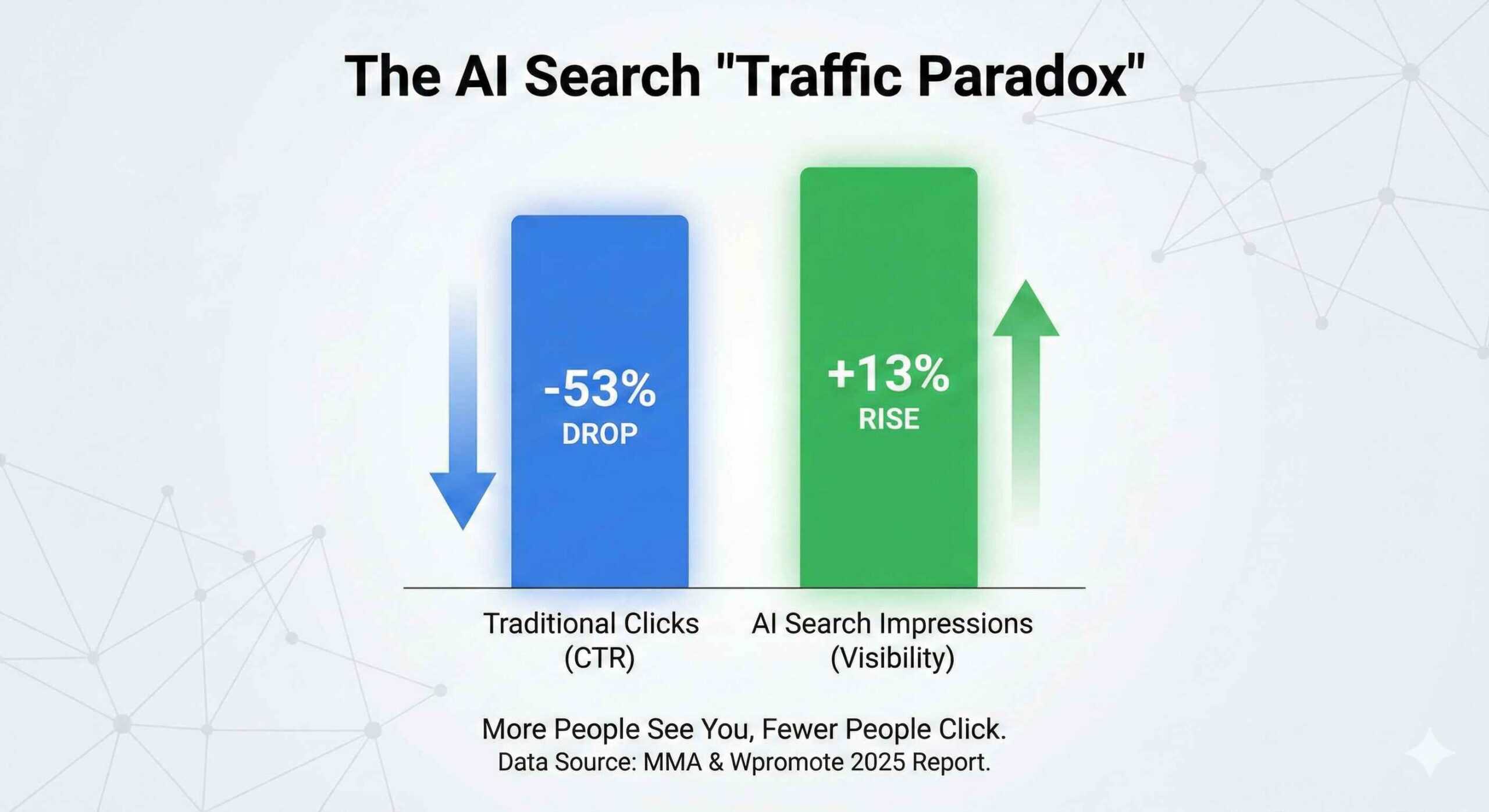
According to a 2025 industry analysis by MMA Global and Wpromote, we have officially entered the “Traffic Paradox.” Their data reveals a startling trend in AI-enhanced search environments: businesses are seeing a 13% increase in impressions (their brand name appearing on screen) alongside a massive 53% decrease in actual clicks to their websites.
People are seeing you, but they aren’t visiting you. Why? Because the AI is doing the job for them.
This isn’t just about convenience; it’s about a fundamental shift in consumer trust. We used to trust the Google algorithm to rank the best options. Now, we trust the AI to read those options for us. The same research indicates that 83% of consumers now trust AI-generated search results as much as, or even more than, traditional organic links.
If an AI tells a user that your Halifax accounting firm is the “most reliable for small business taxes based on recent reviews and industry citations,” that user doesn’t feel the need to verify it by visiting your homepage. The “pre-click” experience is now the entire experience.
The “Halifax Gap”: A Dangerous Lag (And a Massive Opportunity)
While this shift is global, the implications for Halifax are unique. Canada, despite being a global hub for academic AI research, is lagging dangerously behind in business adoption.
A 2025 government report from ISED Canada highlights a significant “Adoption Gap,” revealing that only 12.5% of Canadian small and medium-sized enterprises (SMEs) have fully integrated AI tools into their operations. Further conflicting data from Statistics Canada suggests the number using AI in actual production (rather than just experimenting) is as low as 12.2%.
What does this mean for a business owner in the HRM?
It means your local competitors are likely asleep at the wheel. They are still pouring money into outdated SEO tactics, fighting for clicks that no longer exist.
This creates a massive, temporary window of opportunity. The Halifax businesses that recognize this shift now and optimize for AI discovery can establish dominance before the rest of the market wakes up. The economic stakes are huge; Toronto Metropolitan University projects that generative AI could add up to $100 billion annually to the Canadian economy by 2030. The businesses that figure out how to be “the answer” the AI provides will capture the lion’s share of that local growth.
Furthermore, the traffic you do get from AI is better. A study on Canadian brand Freedom Mobile found that implementing AI discovery layers led to a 15% growth in customer sessions, and more importantly, the users interacting with these AI layers had a 5.5% higher Average Order Value (AOV) than those using traditional search.
The goal is no longer more traffic; it is smarter, AI-qualified traffic.
The New Playbook: If You Can’t Get the Click, Get the Citation
If CTR is dying as a primary metric, what replaces it?
In 2026, the new currency of the web is “Citations” and “Brand Mentions.”
AI models are essentially giant research assistants. They don’t just look at your website; they scan the entire web to see what others are saying about you. They are looking for consensus, authority, and trustworthiness across third-party sources.
The data bears this out: 2025 strategy documents from the MMA indicate that brands with a high volume of third-party mentions are 3x more likely to appear in AI search results compared to those focusing only on their own content.
To win in Halifax, you need to stop obsessing over your website’s keyword density and start obsessing over your brand’s digital footprint.
The Halifax Survival Guide for the Zero-Click Era
How does a local restaurant, contractor, or professional service provider in Halifax actually apply this? You need to shift from “Search Engine Optimization” to “AI Answer Optimization.”
Here are three data-backed strategies to pivot your local business:
1. Become “Citeable” Locally (Digital PR over Link Building) Traditional SEO meant getting other sites to link to yours. AI SEO means getting other reputable sources to talk about you. The AI needs to see your business name associated with your service category across the local web.
- The Halifax Action: Get involved in local events that generate news coverage. Ensure you are listed in the Halifax Chamber of Commerce directories. Collaborate with other local businesses on joint projects that get mentioned on their platforms. If you are a plumber in Dartmouth, you want the AI to find multiple sources—local news, community forums, industry directories—all agreeing that you are the “most reliable emergency plumber in Dartmouth.”
2. Optimize Your “Data Layers” (Especially Google Business Profile) For local search, AI models rely heavily on structured data feeds, the most important of which is your Google Business Profile (GBP). AI uses this data to answer questions about hours, services, locations, and current offerings.
- The Halifax Action: Treat your GBP as your second homepage. If you run a cafe on Quinpool, ensure your menu is uploaded in text format (not just a PDF image the AI can’t easily read). Use the Q&A section to seed answers to common questions. If you have live music on Fridays, update that in your posts so when someone asks an AI “Where can I hear live folk music tonight in Halifax?”, your business is the answer.
3. Create “Answer-First” Content In the past, blog posts buried the answer so users had to scroll past ads (and increase “time on site”). In the AI era, this is suicide. If the AI cannot easily extract the answer from the top of your content, it will ignore you and find a source that does.
- The Halifax Action: Look at the questions your customers ask most frequently. Write content that answers those questions immediately in the first paragraph in clear, concise language. Follow it up with depth, local context, and nuance. You want to be the source that the AI quotes verbatim in its summary.
Conclusion: Adapt or Disappear
The data is irrefutable: the traditional path between a search query and a business website is fractured. The drop in clicks is not a temporary glitch; it is the new reality of user behaviour.
For Halifax small business websites, the “Canada Gap” in AI adoption is a gift. It is a chance to stop competing on a playing field that no longer exists and start optimizing for the future of discovery.
You can either mourn the death of the blue link, or you can ensure that when a potential customer in Halifax asks the AI a question about your industry, your business is the only logical answer it provides.
Get found online